Wound-Care Nurse: Lost the Weight, but Your Skin Didn’t Follow? It’s Not Your Cream. It’s What Feeds Your Skin From Underneath.
For 27 years I’ve treated skin that won’t heal. When my sister lost 60 pounds on the shot and started hiding her arms, I finally looked at her skin the way I look at a wound. Here’s what I found, and the three studies that changed what I tell women.
For 27 years, my job has been skin that won’t heal. Diabetic feet. Pressure sores. Surgical wounds that keep opening back up.
Every one of those patients taught me the same rule, and it’s the first thing I teach every new nurse: skin heals from underneath. If the blood doesn’t get there, nothing you put on top matters.
I knew that rule cold. And I still missed it on my own sister.
The day my sister cried in a fitting room
Carol is 61. Last year she lost 60 pounds on the shot. Her blood sugar came down, her knees stopped aching, and I was so proud of her I could burst.
Then we went shopping for a dress for her grandson’s wedding.
I was standing outside the fitting room when I heard her crying. She’d tried on a sleeveless dress, lifted her arms, and watched the skin underneath hang in soft, crinkled folds.
“I did everything right,” she said. “And I look older than before I started.”
She bought a dress with sleeves. In June.
Over the next few months she spent close to $1,000 trying to fix it. A neck cream. A tightening serum. Collagen powder in her coffee. A red-light wand. Two sessions at a med spa.
She’d send me photos and ask, “Is it better?” I’d say “maybe,” because I’m her sister.
It wasn’t.
Why the creams were never going to work
One Sunday Carol lifted her arm to show me, and for the first time I looked at it the way I look at a wound.
I felt sick. The answer was something I teach every single week.
Your skin has layers. The top layer is what you see and touch. That’s where every cream, serum and oil goes. They can make it feel softer for the day, and that part is real.
Under it is a deeper layer. That’s the part that holds your skin up. When it thins out, the top layer has nothing firm to sit on, and it crinkles. That’s the crepey look.
And that deeper layer gets everything it needs from tiny blood vessels underneath it, thinner than a hair. Not from the top. Ever.
The layer that holds your skin up is fed from underneath, by blood. Creams never get there.
That’s the sentence I made Carol say back to me. If you remember one thing from this page, make it that one.
Here’s the part almost nobody tells you. As we get older, blood flow to the skin tends to slow down.1 So the layer that holds your skin up gets less, right when it needs more.
Now add fast weight loss. That layer has a huge job to catch up on: skin that was stretched for years, trying to shrink back, on a supply line that’s running slow.
Since I started explaining it this way, women have written to me with their own names for it. A nurse at a weight-loss clinic calls it the last stop. A grandmother whose friend is a retired cardiac nurse calls it the back door. A widow who still bakes calls it the pilot light. A realtor calls it the third floor, after her plumber. Different pictures. Same sentence.
“But I take collagen. Doesn’t that count?”
Everyone asks me this. Whatever you swallow, collagen included, still has to ride your blood to get to your skin. If the supply line is slow, it doesn’t matter how good the delivery is.
So the question isn’t only what you send your skin. It’s whether the blood is getting there.
So I went looking for something that feeds it from underneath
In wound care, we have ways to get blood to a wound: compression, warmth, special dressings, even oxygen chambers. None of them are things you can do for your arms at home, every day, for months.
So I did what I do when a wound won’t close. I went to the research. I had rules: it had to be tested in women, it had to measure blood flow in the skin itself, and it had to be compared against something. Not mice. Not a customer survey.
I expected to come up empty. I found cocoa.
Cocoa beans are rich in plant compounds called flavanols. They’ve been studied for years for how they help blood vessels relax and open. A few research teams asked the question I was asking: does that reach the skin?
More blood flow reaching the skin
After 12 weeks, the women taking high-flavanol cocoa had more blood flowing in their skin and in the tissue just under it. Their skin also measured denser and better hydrated. The low-flavanol group didn’t see those changes.
Heinrich et al., Journal of Nutrition, 2006
It gets there, and fast
Researchers measured blood flow in the skin after a single serving. It went up within about two hours.
Neukam et al., European Journal of Nutrition, 2007
Smoother skin, but only after six months
At 12 weeks, the researchers found nothing. No difference they could measure.
At 24 weeks, the women taking cocoa flavanols had measurably smoother skin, and one of three measures of elasticity had improved.
Yoon et al., Journal of Nutrition, 2016. The cocoa was supplied by a chocolate company, Barry Callebaut.
That third study is the one I’d point you to first. A company making things up would promise you two weeks. These researchers reported that nothing showed for three months, then published what they saw at six. That’s how real skin works. I watch it heal on that clock every day.
How much is in two capsules of Equora: about 320 mg of cocoa flavanols. That’s the daily amount the women took in the 12-week and six-month studies.
What I tell women the studies did not show
- Loose skin didn’t disappear. Nothing you swallow will do that, and I won’t tell you otherwise.
- No sun protection.2 Keep your sunscreen.
- The studies are small. A 2021 review called the skin research promising but not settled.3
Why the cocoa in your pantry won’t do it
Most cocoa powder is “Dutch-processed,” and that can strip out most of its flavanols.4 Hot cocoa mix is mostly sugar. A chocolate bar comes with sugar and fat, and no way to know how much you’re getting.
And I knew my sister wasn’t going to drink a special mug of anything every day for six months.
The capsule I found
So I went looking for a capsule that gives you the studies’ kind of daily amount without the mug. The one I landed on is Equora Cocoa Flavanols. Two capsules with breakfast. Nothing to mix, nothing to rub in, no sugar.
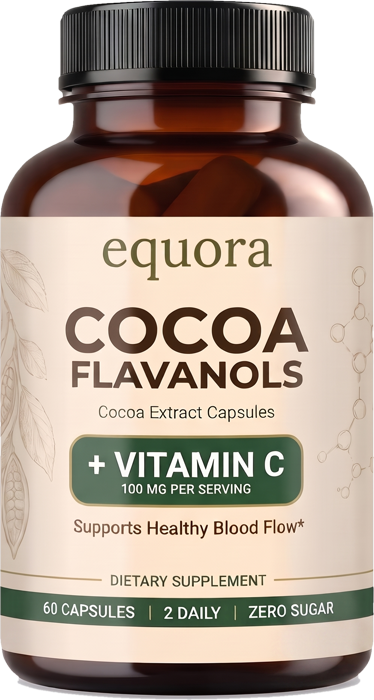
- 600 mg cocoa flavanol blend in every serving
- 100 mg vitamin C, which helps your body make collagen†
- Made in a cGMP-certified facility
- Made to support healthy blood flow to your skin†
Not a sprinkle for the label. Two capsules give you the full daily amount the studies used.
To be clear: the studies tested cocoa flavanols, not this capsule. Equora is just the easiest way I found to take that amount every single day.
Carol was the first person I gave it to
Two capsules every morning with her coffee. On day one I took a photo of the back of her arm, same mirror, flash on. She hated that.
The first month, nothing. She texted me every Sunday: “Anything?” I told her what the studies said: this is slow, and that’s how you know it’s real.
Around week eight, her daughter asked what lotion she’d switched to. She hadn’t switched lotions.
At week 24 we put the photos side by side on her kitchen table. Her arms are 61-year-old arms. They’re not 30. But the skin looked smoother, and it didn’t crinkle the way it did in that fitting room.
That August she wore a sleeveless dress to her granddaughter’s graduation party. Nobody said a word. That was the whole point.
How I tell women to take it
This is slow. I’d rather you know now than quit at week four.
Take a photo of the spot that bothers you most: the back of your arm, your neck, your chest. Same mirror, same light, flash on. You’ll want it later.
Probably nothing you can see. That’s normal. Keep going, two capsules with breakfast.
Your first fair check. In the 12-week study, more blood was reaching the skin by now. In the six-month study, smoothness hadn’t changed yet. Take the second photo anyway.
Where the six-month study measured smoother skin. Take the third photo, same mirror, same light, and compare.
That’s why I tell women to start with three or five bottles. One bottle is 30 days, and 30 days isn’t a fair test of anything.
What it costs, next to what you’ve tried
| One small bottle of tightening serum | $89 |
| One radiofrequency session at a med spa | $300 |
| An LED light mask | $399 |
| Equora, 3 bottles (90 days) | about $1 a day |
Keep your creams if you like them. They’re fine for the top layer. This is for the layer underneath.
Choose your supply
 1 Bottle30 days
$44.95
Covers the first check
 3 BottlesBuy 2, Get 1 Free · 90 days · free shipping
$89.95
 5 BottlesBuy 3, Get 2 Free · 150 days · free shipping
$134.95
money-back
Try it for 90 days, risk-free. Take it every morning. If you see nothing, or you’re not happy for any reason, email us within 90 days and we’ll refund your money. No questions asked. That’s what makes a slow start easier to sit through.
One last thing from me
If you lost the weight and you’re still reaching for a cardigan in July, I want you to hear this from a nurse: you didn’t do anything wrong, and your cream didn’t fail you. It was working on the wrong layer.
Feed the one underneath. Give it six months. Take the photos.
And if you know a woman who’s quietly stopped wearing short sleeves, send her this. She probably won’t bring it up herself.
- Bentov I, Reed MJ. The effect of aging on the cutaneous microvasculature. Microvasc Res. 2015 (PMC4461519). Kenney WL. Skin-deep insights into vascular aging. J Appl Physiol. 2017.
- Mogollon JA et al. Chocolate flavanols and skin photoaging: a double-blind, randomized, controlled trial. Nutr J. 2014;13:66.
- Systematic review of chocolate and cocoa and skin outcomes, 2021 (PMC8470865).
- Miller KB et al. Impact of alkalization on the antioxidant and flavanol content of commercial cocoa powders. J Agric Food Chem. 2008;56:8527-33.
- Heinrich U et al. Long-term ingestion of high flavanol cocoa provides photoprotection against UV-induced erythema and improves skin condition in women. J Nutr. 2006;136:1565-9. (Study 1)
- Neukam K et al. Consumption of flavanol-rich cocoa acutely increases microcirculation in human skin. Eur J Nutr. 2007;46:53-6. (Study 2)
- Yoon HS et al. Cocoa flavanol supplementation influences skin conditions of photo-aged women: a 24-week double-blind, randomized, controlled trial. J Nutr. 2016;146:46-50. (Study 3)
THIS IS AN ADVERTISEMENT FROM EQUORA, NOT A NEWS ARTICLE. The studies above tested cocoa flavanols; they did not test Equora. The narrator and the stories on this page are illustrative. Individual results vary.
† These statements have not been evaluated by the Food and Drug Administration. This product is not intended to diagnose, treat, cure, or prevent any disease. Talk to your doctor before use if you’re pregnant or nursing, take any medication (blood pressure, blood thinners or diabetes medication especially), have surgery coming up, or are under 18.
Questions? info@tryequora.com · Privacy · Terms · Refunds